
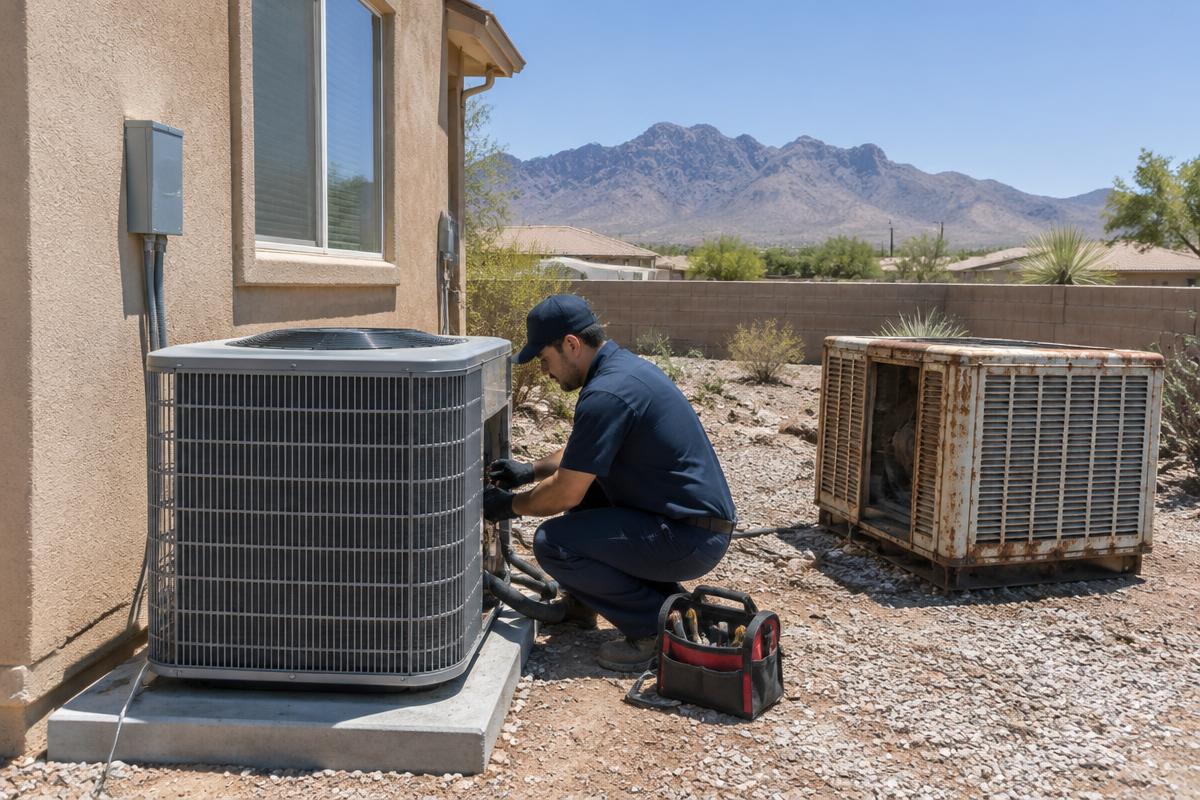
Evaporative Cooling vs. Refrigerated Air
The two systems cool a house in completely different ways, and the difference shows up most on humid or dusty days.
- Evaporative (swamp) coolers: blow air across water-soaked pads, cooling by evaporation. They work well in dry air but lose effectiveness as humidity rises, and they add moisture to the home.
- Refrigerated air conditioners: use a sealed refrigerant system with an indoor coil and outdoor condenser, cooling the air to a set temperature regardless of outdoor humidity.
- Comfort: refrigerated air holds a set temperature; evaporative cooling cools a moving stream of air, so windows or doors usually stay open.
- Air quality: with refrigerated air, windows stay closed during dust storms and allergy season, and the air can be filtered as it circulates.
Why El Paso Homeowners Convert
El Paso has one of the longest cooling seasons in the country, and evaporative coolers struggle most exactly when you need cooling most: humid monsoon afternoons in July and August. Monsoon-season moisture makes swamp coolers feel sluggish and can leave the house muggy.
Refrigerated air also lets you keep the house sealed up. During dust storms and high-pollen days, an evaporative cooler keeps pulling outside air through the house, while a refrigerated system circulates and filters indoor air instead. For many families, those two factors — monsoon comfort and sealed-up dust control — are what finally justify the upgrade.
What a Conversion Involves
A refrigerated air conversion is more than swapping one box for another. The house changes from a system that moves large volumes of outdoor air to one that recirculates a smaller volume through a sealed refrigerant circuit. A typical conversion addresses:
- Removing the old evaporative cooler, its pad frame, and its water supply and drain lines.
- Setting a new outdoor condenser on a level pad and connecting refrigerant lines.
- Installing or adapting an indoor coil and blower, often replacing or modifying the old cooler's duct connection.
- Checking and upgrading electrical circuits where the new equipment requires them.
- Sealing and modifying ductwork so the new airflow pattern is balanced room to room.
- Installing a compatible thermostat and testing the full system operation.
Existing Ductwork Considerations
Ductwork is the part of a conversion homeowners most often underestimate. Evaporative coolers move a very large volume of air through big duct openings, while refrigerated air moves a smaller volume under higher pressure. Ducts designed for a swamp cooler can work, but they frequently need resizing, added return-air capacity, sealing, or new transitions — otherwise the new system may be noisy in some rooms and weak in others.
An inspection of the ducts should happen before equipment is chosen, not after. Leaky ducts in a hot attic waste cooled air, and undersized return paths choke airflow. When ductwork needs rebuilding, having it custom-built rather than patched makes a real difference in how evenly the house cools. Our duct fabrication page explains how custom ductwork is made to fit.
Cooling Load and Equipment Sizing
Choosing equipment starts with a load calculation that considers the home's square footage, insulation, window orientation, ceiling heights, and air leakage — not just the size of the old cooler. An oversized air conditioner short-cycles and leaves rooms uneven; an undersized one runs constantly on the hottest afternoons and still falls behind.
Sizing also affects long-term cost. A correctly sized system cycles comfortably, manages humidity better, and typically lasts longer than one that was guessed at. Our AC installation page covers sizing and efficiency ratings in more depth.
Electrical and Equipment Considerations
A condenser needs a dedicated circuit, and some older homes need electrical work before new equipment can run safely. Panel capacity, disconnect placement, and wiring condition should all be evaluated during planning. If a heat pump is being considered instead of a straight cooling system, the electrical requirements are similar, and El Paso's mild winters make heat pumps worth discussing.
Equipment efficiency (SEER2) is another planning input. Higher-efficiency equipment costs more upfront but can mean lower operating costs over El Paso's long cooling season. The right balance depends on your budget and how long you plan to stay in the home.
Planning the Installation
A well-planned conversion usually follows a sequence: assessment of the home and existing equipment, a load calculation and ductwork inspection, a written proposal describing the equipment and scope, the installation itself (typically scheduled over one or more days depending on the scope), and a final testing and walkthrough. Permits may be required depending on the work involved, and any permit requirements are part of the planning conversation.
Timing matters too. Conversion schedules fill up fastest in late spring, when homeowners who sweated through the first hot weeks all call at once. Planning in winter or early spring gives you the widest choice of scheduling.
Factors That Affect Conversion Cost
Every conversion is priced from the specifics of the house, so honest cost conversations start with an assessment rather than a generic number. The main factors that move the price up or down include:
- The condition and capacity of existing ductwork, and how much of it needs modification.
- Whether the electrical panel and circuits need upgrades.
- The equipment efficiency level and system type selected.
- Roof or ground placement of equipment and the length of refrigerant line runs.
- Whether the old cooler, its stand, and water lines need removal and patching.
- The size and layout of the home, including additions or converted spaces.
What to Expect
- 01
Home assessment
We look at the existing cooler, ductwork, electrical capacity, and how the home is built.
- 02
Sizing and proposal
A load calculation and duct inspection lead to equipment options and a written scope.
- 03
Conversion installation
Old equipment comes out; the new refrigerated air system goes in, including duct and electrical work.
- 04
Testing and walkthrough
The system is tested, airflow is verified, and you get a walkthrough of how to run and maintain it.